When people hear the word “Titin”, they usually think of one thing: the longest scientific name in the world. Students, science lovers, and even meme fans search online for the scientific name for titin out of curiosity. Some want it for school projects, others for fun facts, and many just want to see how long that name really is.
Titin is a giant protein found in our muscles. It plays a huge role in helping our muscles stretch, move, and remain strong. Although many people believe titin’s chemical name is the “longest word in English,” the truth is a little more scientific than that.
In this article, you will learn the real scientific name of titin, what it does, where it is found in the body, and why it matters so much in biology.
Let’s explore everything about titin in the easiest way possible.
The scientific name for sheep is Ovis aries.
Here’s what it means:
Ovis = Latin word meaning “sheep”
Aries = Means “ram” or “male sheep”
So, the full scientific name means “The domestic sheep.”
It shows that sheep belong to the Bovidae family, the same family as goats, cows, and antelope. Sheep are gentle farm animals known for their wool, meat, and milk.
What Is the Scientific Name for Titin? 🧬
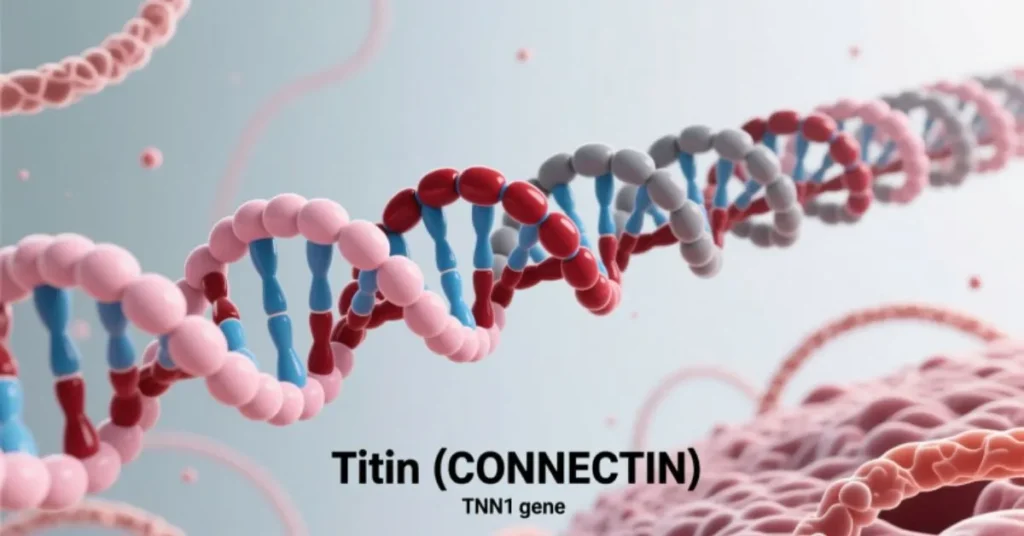
The scientific name for titin is simply:
Titin (protein)
or
Connectin
Its gene name is:
TTN
Many people think titin’s scientific name is a super long word made of more than 180,000 letters. That extremely long name is actually the chemical name describing every atom in the protein, not the official scientific name.
In real scientific use, experts call it:
Titin
Gene: TTN
So, the true, accepted scientific name is just Titin.
Why Is Titin So Famous? 🌍
Titin is famous for three big reasons:
- It is the largest known protein in the human body.
- It helps muscles stretch and return to their shape.
- It is connected to the longest chemical word ever recorded.
Titin is so long that if you tried to say its full chemical name out loud, it would take you more than 3 hours without stopping. That’s why it is not written in normal dictionaries.
This has made titin a popular topic in:
- Schools
- Biology classes
- Science videos
- Fun fact websites
- TikTok and YouTube
Where Is Titin Found in the Human Body? 🫀
Titin is found in muscle cells. It is especially important in:
- Heart muscles
- Skeletal muscles
- Smooth muscles
It connects two important parts inside a muscle cell:
- Z-line
- M-line
By connecting these parts, titin helps:
✅ Control muscle stiffness
✅ Keep muscle structure stable
✅ Support normal movement
✅ Prevent muscle damage
Without titin, your muscles would not work properly.
What Does Titin Actually Do? 💪
Titin has many important jobs in your body:
• Keeps muscles elastic
• Helps muscles relax after stretching
• Protects muscles from injury
• Controls muscle tension
• Supports heart function
It acts like a spring inside your muscles. When you stretch, titin stretches. When you relax, titin returns to normal.
That’s why it is called a “molecular spring.”
Is Titin a Chemical Compound? ⚗️
No, titin is not a simple chemical compound like water (H₂O) or salt (NaCl).
It is a protein, made of:
- Amino acids
- Carbon
- Hydrogen
- Nitrogen
- Oxygen
- Sulfur
Titin has more than 244 individual protein domains, which makes it extremely complex and special.
The Myth of the Longest Word 📚
You may have heard that the scientific name for titin is the longest word in the English language. Technically, that super long name is the full chemical description of titin, not the scientific name.
The real scientific name is still just:
👉 Titin
That’s the word used by scientists around the world.
Who Discovered Titin? 🔍
Titin was discovered in 1977 by scientists studying muscle fibers.
They found a giant elastic protein that kept the muscle structure in place. This new protein was so big that they named it titin, after the Titans of Greek mythology (giants with great power).
Diseases Related to Titin 🏥
When the TTN gene is damaged or mutated, it can cause serious health problems such as:
- Cardiomyopathy (heart disease)
- Muscle weakness
- Muscle stiffness disorders
- Irregular heartbeat
That is why doctors and researchers study titin very carefully today.
Fun Facts About Titin 🎯
Here are some fun facts:
✅ Largest known protein in humans
✅ Has more than 34,000 amino acids
✅ Gene contains 364 exons
✅ Stretchable like a rubber band
✅ Important for heartbeat
✅ Known worldwide for its long chemical name
Titin is not just a weird science fact. It is essential for life.
Why Students Search “Scientific Name for Titin”? 📖

Most people search this keyword because:
- It’s asked in school exams
- It’s used in science quizzes
- It’s famous in memes
- It’s an interesting record
- They want to know the longest word
That’s why understanding the simple answer matters:
✅ Scientific name for titin = Titin
✅ Gene name = TTN
Is the Long Chemical Name Used in Science? ❌
No. Scientists do not use the 180,000-character name in real work. It’s too long and useless for daily science communication.
In every research paper, medical journal, or textbook, they simply write:
Titin (TTN)
Difference Between Common Name & Chemical Name 🧪
| Type | Name |
| Scientific Name | Titin |
| Gene Name | TTN |
| Chemical Name | Extremely long (180,000+ letters) |
| Common Use | Titin |
This makes it simple and clear.
Conclusion ✅
The scientific name for titin is simply “Titin.” While its chemical composition creates the longest word in the world, scientists never use that full name in real life. Titin is an essential protein found in your muscles. It keeps them strong, flexible, and able to move properly.
It plays a huge role in human health, muscle function, and heart performance. That’s why titin is not just famous, it is vital to life.
If you were searching for the scientific name, the answer is clear and simple:
👉 Titin (TTN)
A small word with a massive impact.