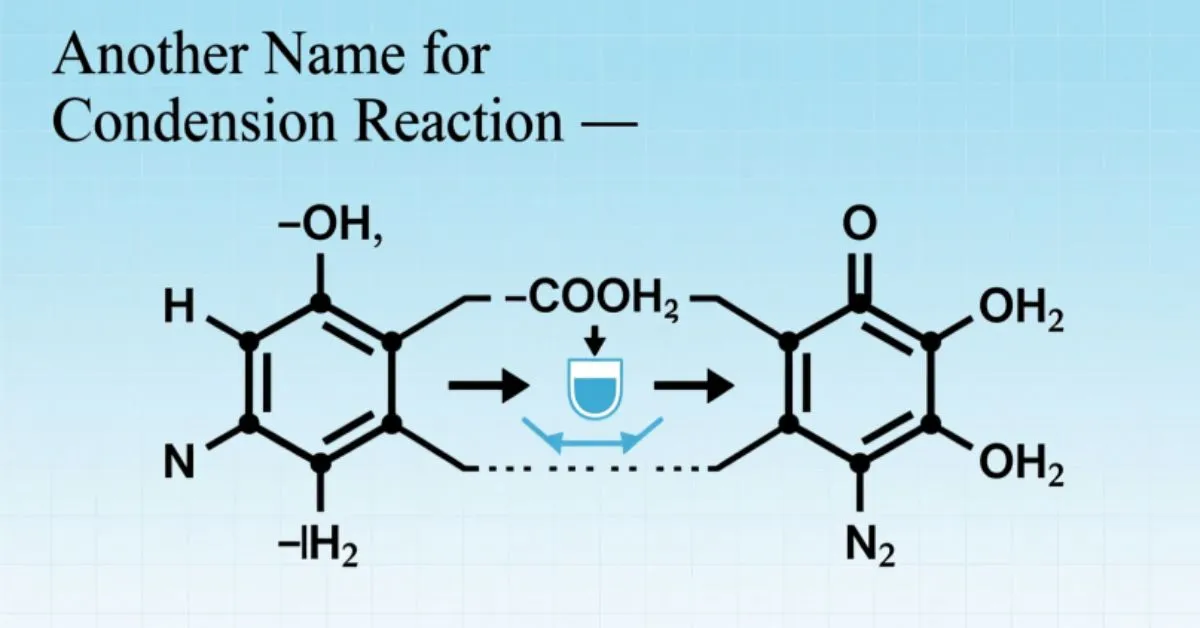
If you’ve ever opened a chemistry book or studied biomolecules, you’ve probably come across the term condensation reaction. And if you’re like many students or curious readers, you’ve wondered: “Is there another name for a condensation reaction? Or maybe simpler words to describe it?”
People search for this because chemistry terms can be confusing. A single reaction may appear under different names in textbooks, biology notes, or lab manuals.
Knowing all the alternative names helps you understand concepts faster, score better in exams, and recognize reactions even when they’re written differently.
This guide gives you simple, memorable, and beginner-friendly nicknames for condensation reactions. Each one is explained in short, clear language (Hemingway Grade 3 style).
If you’re a student, a teacher, or just curious, you’ll leave with a complete understanding of what condensation reactions are and what other names people use.
⭐Official Scientific Names for Condensation Reactions 🔬
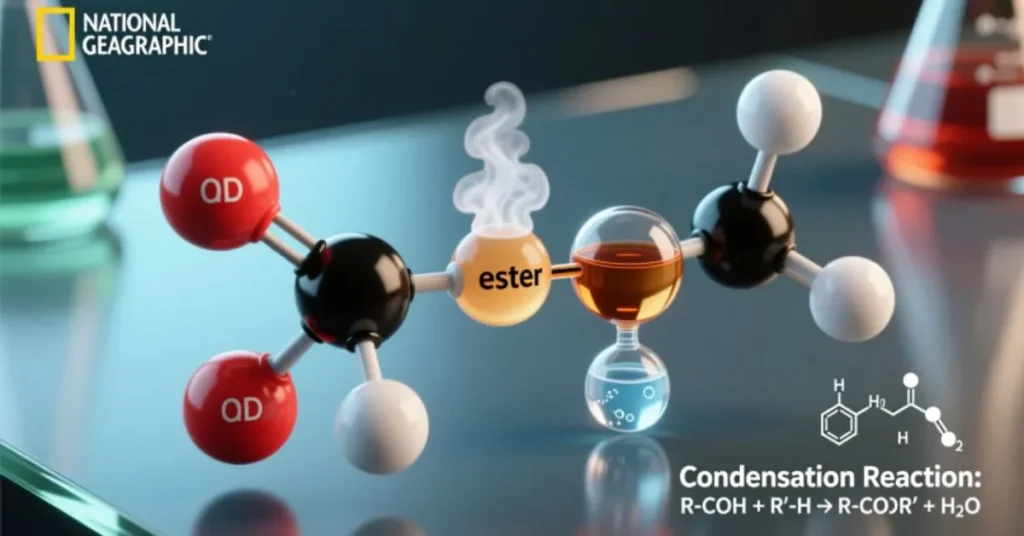
Condensation reactions have a few formal names used in chemistry and biochemistry. These names help students recognize the reaction type in academic settings.
1. Dehydration Reaction
Meaning: Water is removed during the reaction.
2. Dehydration Synthesis
Meaning: Removing water to build a larger molecule.
3. Condensation Synthesis
Meaning: Two molecules join, water is released.
4. Biosynthetic Condensation
Meaning: Condensation in biological systems.
5. Anabolic Condensation
Meaning: A reaction that builds larger molecules in living organisms.
6. Water-Releasing Reaction
Meaning: The reaction forms water as a by-product.
7. Step-Growth Condensation
Meaning: Used in polymer chemistry for stepwise growth.
8. Polycondensation Reaction
Meaning: Condensation process used to form polymers.
9. Eliminative Condensation
Meaning: A condensation reaction involving removal of small molecules.
10. Molecular Joining Condensation
Meaning: Two molecules combine into one.
⭐Simple Classroom Nicknames for Condensation Reactions 🧪
When teachers explain the concept to beginners, they often use simple nicknames.
1. Water-Out Reaction
Meaning: Water leaves the reaction.
2. Join-Together Reaction
Meaning: Two things join to make one bigger thing.
3. Build-Up Reaction
Meaning: A small-to-big molecule reaction.
4. Combine-and-Release Reaction
Meaning: Molecules combine and release something (usually water).
5. Pairing Reaction
Meaning: Two molecules become a pair.
6. Bond-Making Reaction
Meaning: A new bond forms between molecules.
7. Linking Reaction
Meaning: Two molecules link through chemical bonding.
8. Water-Dropping Reaction
Meaning: Water “drops out” of the process.
9. The “Fusion” Reaction
Meaning: Molecules fuse together.
10. Form-Together Reaction
Meaning: New molecule forms from two smaller ones.
⭐Biology-Friendly Alternative Names for Condensation Reactions 🧬
In biology, condensation reactions help form DNA, proteins, and carbohydrates. Teachers use biology-based nicknames.
1. Protein-Forming Reaction
Meaning: Builds amino acids into proteins.
2. Peptide Bond Reaction
Meaning: Forms peptide bonds by removing water.
3. Sugar-Link Reaction
Meaning: Links monosaccharides into polysaccharides.
4. DNA-Building Reaction
Meaning: Helps join nucleotides together.
5. Polymer Growth Reaction
Meaning: Builds biological polymers.
6. Biomolecule Fusion
Meaning: Joins biological molecules.
7. Cell-Building Reaction
Meaning: Helps construct essential cell structures.
8. Macromolecule Formation
Meaning: Creates large biological molecules.
9. Growth Chemistry Reaction
Meaning: Builds bigger molecules for growth.
10. Water-Loss Biosynthesis
Meaning: Water is lost as biomolecules form.
⭐Nicknames Used in Organic Chemistry 🧱
Organic chemistry often gives specific names to condensation reactions depending on the mechanism.
1. Aldol Condensation
Meaning: Reaction between aldehydes/ketones forming β-hydroxy compounds.
2. Claisen Condensation
Meaning: Reaction between esters to form β-keto esters.
3. Knoevenagel Condensation
Meaning: Creates carbon-carbon bonds between active methylene groups and carbonyls.
4. Dieckmann Condensation
Meaning: Internal ester condensation creating cyclic β-keto esters.
5. Perkin Condensation
Meaning: Aromatic aldehydes react with anhydrides.
6. Mannich Reaction
Meaning: Amino alkylation involving condensation.
7. Acylation Condensation
Meaning: Adding acyl groups with small molecule loss.
8. Schiff Base Formation
Meaning: Amines and aldehydes condense.
9. Ester-Forming Condensation
Meaning: Alcohols and acids form esters.
10. Amide-Forming Condensation
Meaning: Amines and acids form amides.
⭐Nicknames Students Use to Remember the Concept 📘
These are memory tricks students use to simplify the reaction.
1. “The Water-Making Reaction”
Meaning: Water forms as a by-product.
2. “Two Become One”
Meaning: Two molecules turn into one.
3. “The Drought Reaction”
Meaning: Water disappears.
4. “Stick-Together Reaction”
Meaning: Parts stick together.
5. “Bond-Party Reaction”
Meaning: New bonds are introduced.
6. “Drop-and-Join Reaction”
Meaning: Something is dropped (water) while joining.
7. “The Builders’ Reaction”
Meaning: Builds bigger molecules.
8. “The Glue Reaction”
Meaning: Acts like glue in biomolecules.
9. “Water-Release Reaction”
Meaning: Water gets released.
10. “The Big-Making Reaction”
Meaning: Makes small molecules big.
⭐Nicknames Based on What Happens in the Reaction ⚗️
These names describe the chemical process itself.
1. Water-Elimination Reaction
Meaning: Water is removed.
2. Loss-of-Molecule Reaction
Meaning: A small molecule gets eliminated.
3. Condense-and-Create Reaction
Meaning: Molecules condense into one.
4. Reduction of Reactants Reaction
Meaning: Reactants reduce in count.
5. Union Reaction
Meaning: Molecules unite.
6. Assembly Reaction
Meaning: Assembles larger structures.
7. Merging Reaction
Meaning: Two become one.
8. Group-Bonding Reaction
Meaning: Functional groups bond.
9. Synthesis-Through-Loss Reaction
Meaning: Synthesis happens as something is lost.
10. Eliminative Synthesis
Meaning: Synthesis by elimination.
⭐Polymers and Condensation Reactions 🧵
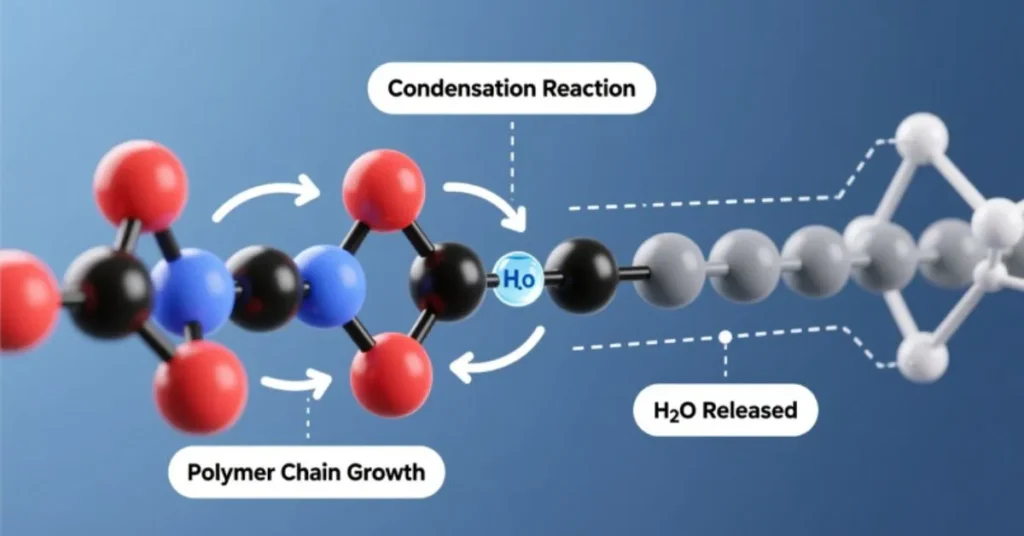
Polymer sciences use condensation reactions heavily.
1. Polymerization Condensation
Meaning: Polymer formation via condensation.
2. Step-Growth Polymerization
Meaning: Polymers grow stepwise.
3. Nylon-Forming Reaction
Meaning: Nylon created through condensation.
4. Polyester-Forming Reaction
Meaning: Polyesters form through condensation.
5. Resin-Building Reaction
Meaning: Resins created from monomers.
6. Chain-Link Reaction
Meaning: Links monomers.
7. Macro-Building Reaction
Meaning: Makes macromolecules.
8. Polymer Chain Reaction
Meaning: Chains lengthen by condensation.
9. Slow-Growth Reaction
Meaning: Polymers grow slowly via condensation.
10. Step-Bond Reaction
Meaning: Bonds add step by step.
⭐Nicknames Based on Everyday Analogies 🍯
Fun and easy names to understand.
1. “The Lego Reaction”
Meaning: Small pieces click into bigger ones.
2. “The Puzzle Reaction”
Meaning: Pieces connect perfectly.
3. “The Water-Drop Reaction”
Meaning: Drops of water fall out.
4. “The Sticky Reaction”
Meaning: Molecules stick.
5. “The Combine Reaction”
Meaning: Combine pieces.
6. “The Fusion Reaction”
Meaning: Fusion of parts.
7. “The Build-Up Reaction”
Meaning: Builds something bigger.
8. “The Pair-Up Reaction”
Meaning: Two get paired.
9. “The Link-Together Reaction”
Meaning: Links units.
10. “The Water-Out Build”
Meaning: Water leaves as building occurs.
⭐Nicknames Found in Biochemistry Textbooks 📚
Many textbooks give alternate labels to simplify learning.
1. Anabolic Water-Loss Reaction
Meaning: An anabolic reaction releasing water.
2. Enzyme-Driven Condensation
Meaning: Condensation via enzymes.
3. Peptide-Bonding Condensation
Meaning: Creates peptide bonds.
4. Glycosidic Bond Reaction
Meaning: Sugar units bond.
5. Nucleotide Linking Reaction
Meaning: DNA/RNA chains form.
6. Esterification Condensation
Meaning: Ester forms, water lost.
7. Amide Formation Condensation
Meaning: Amide bond forms.
8. Polymer Biosynthesis Reaction
Meaning: Biological polymers form.
9. Macromolecular Condensation
Meaning: Big molecules created.
10. Water-Loss Polymerization
Meaning: Polymer made with water loss.
⭐Nicknames That Highlight What Leaves the Reaction 💧
Many names highlight what is released.
1. H₂O-Release Reaction
Meaning: Water is released.
2. Alcohol-Release Reaction
Meaning: Alcohol forms as a by-product.
3. Acid-Release Reaction
Meaning: Acids leave the reaction.
4. Ammonia-Release Reaction
Meaning: Ammonia is produced.
5. CO₂-Release Reaction
Meaning: Carbon dioxide exits.
6. Small-Molecule Loss Reaction
Meaning: A small molecule is lost.
7. Release-Based Condensation
Meaning: Reaction that releases something.
8. Gas-Dropping Reaction
Meaning: Gas released.
9. Vapor-Out Reaction
Meaning: Vapor leaves.
10. Molecule-Exit Reaction
Meaning: Any small molecule exits.
⭐ Conclusion
Condensation reactions have many names formal, fun, textbook-based, and student-friendly. Whether you call it dehydration synthesis, water-loss reaction, or even the Lego reaction, the meaning stays the same: two molecules join, and a small molecule leaves.
These nicknames help you remember the concept easily and recognize it in exams, labs, and textbooks. Choose the nickname that fits your learning style and make chemistry simple and enjoyable!